

Language Solutions for Every Stage of Your Clinical Trials & Research Projects
COA Validation | Translation | Interpretation English ↔ Spanish

Leave your clinical validation and research projects in the hands of an expert linguist and validator
Seamless linguistic services that ensure regulatory compliance and research success in Spanish-speaking markets

COA/eCOA Linguistic Validation Services
Transform your Clinical Outcome Assessments and Patient-Reported Outcome Measures into culturally appropriate Spanish versions that maintain clinical validity and meet regulatory requirements. From forward and backward translation to cognitive debriefing coordination, I ensure your instruments resonate with Spanish patients while preserving psychometric properties. Specialized in English to Spanish (Spain) validation for pharmaceutical companies, CROs, and language service providers conducting clinical trials.
Clinical & Pharmaceutical Translation Services
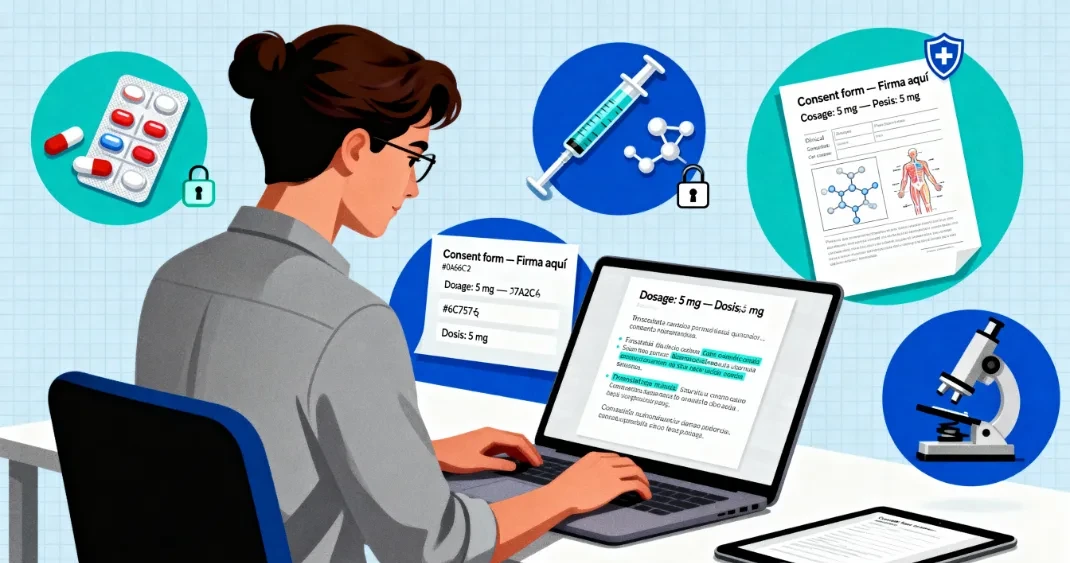
From clinical trial protocols to regulatory submissions, informed consent forms to patient recruitment materials, I translate your medical documents with clinical precision and cultural accuracy. Whether you need medical device documentation, investigator brochures, or clinical study reports, you’ll receive regulation-ready translations that meet ICH-GCP standards and Spanish regulatory requirements.

Market Research Translation Services
From screeners to discussion guides, questionnaires to consumer journals, I translate your research materials into Spanish so they’re clearly understood and culturally relevant to Spanish-speaking participants. Once your project is complete, I also translate findings reports, client presentations, executive summaries, and transcripts to ensure complete clarity and actionable insights.

Remote Simultaneous Interpretation
Sometimes it’s more convenient and cost-effective to conduct research remotely. I provide web-assisted simultaneous interpretation for virtual focus groups, online interviews, and teleconference meetings with Spanish-speaking participants. Save time and resources while ensuring accurate, real-time interpretation of every nuanced response and cultural insight.

On-site Simultaneous Interpretation
Rely on me for Spanish to English simultaneous interpretation of in-person interviews, focus groups, research clinics, ethnographic studies, and shop-alongs. I ensure every word, meaning, and cultural nuance is accurately interpreted, providing you with insights as clear as if spoken in your own language. I also provide cultural context to help you better understand and position participants’ comments.

Post-Editing Machine Translation (PEMT)
Optimize your machine-translated content with professional post-editing services. I refine MT output to ensure linguistic accuracy, cultural appropriateness, and regulatory compliance for both clinical and market research materials. Cost-effective solution for high-volume translation projects requiring quick turnaround without compromising quality.
Listen to me
Ready to Start Your Project?
Do you need COA/eCOA linguistic validation, clinical translation, or professional simultaneous interpretation for your research project? With over 25 years of experience, a Ph.D. in Linguistics, and specialized training in clinical instrument validation, you can look forward to culturally precise, regulation-ready language services that ensure your success in Spanish-speaking markets.
I’m here to help –let’s discuss how I can support your clinical trials and research excellence.
F.A.Q
Frequently Asked Questions about Linguistic Validation
Technical/Process Questions:
What is COA/eCOA linguistic validation?
It’s the process of adapting Clinical Outcome Assessments so they work in another language—not just accurate words, but culturally appropriate questions that Spanish patients understand the same way English-speaking patients do. This way, the Spanish version measures exactly what the original measures through translation, back-translation, and testing with actual patients.
I follow the ISPOR Principles of Good Practice for Translation and Cultural Adaptation, the internationally recognized standard for instrument validation.
eCOA is the electronic version (tablets, apps). Same validation process, digital delivery.
What does linguistic validation add?
Translation is the foundation—accurate, culturally appropriate language. Validation builds on that by testing whether the translation works as a clinical measurement tool.
This requires multiple translators, back-translate to verify accuracy, and test with real patients to confirm they understand questions and response options as intended. Translation gives you precise language. Validation confirms it produces reliable data. For COAs, you need both.
What's included in the linguistic validation process?
- Forward translation by two independent translators
- Reconciliation into one optimal version
- Backward translation to verify conceptual accuracy
- Cognitive debriefing with 5-8 target patients
- Refinement based on patient feedback
- Final proofreading and comprehensive validation report
How long does COA/eCOA validation typically take?
Simple questionnaire (10-20 items): 4-6 weeks
Complex instrument with multiple modules: 6-8 weeks
Timeline depends on instrument complexity and patient availability for cognitive testing. I’ll work with your schedule requirements. Rush projects are possible when needed—we just can’t skip the patient testing step.
What regulatory guidelines do you follow?
I follow internationally recognized frameworks including:
- ISPOR Principles of Good Practice for Translation and Cultural Adaptation
- FDA Patient-Reported Outcome (PRO) Guidance for industry
- EMA guidance on health-related quality of life (HRQL) measures and Patient-Reported Outcomes in medicinal product evaluation
These guidelines ensure your validated instruments meet regulatory requirements for clinical trials across European and international markets. Your Spanish COAs will be ready and compliant with regulatory expectations.
Business/Practical Questions:
Do you work with all therapeutic areas?
Yes. I’ve worked across oncology, cardiology, neurology, respiratory diseases, metabolic disorders, psychiatric conditions, and rare diseases. My PhD in Linguistics and 25+ years in medical translation give me the foundation to quickly understand new therapeutic areas and their specific terminology. I research the specific condition, review any existing validated instruments in the area, and ensure I understand the patient population before starting translation work.
If your therapeutic area requires highly specialized clinical expertise beyond linguistic validation, I’ll let you know upfront and can collaborate with your medical consultants to ensure accuracy.
Can you handle both forward and backward translation?
Yes, I handle forward translation personally (English to Spanish). For backward translation (Spanish back to English), I work with qualified colleagues who are independent from the forward translation process—this independence is required by ISPOR guidelines to ensure unbiased verification.
This two-translator approach catches nuances a single translator might miss and ensures conceptual equivalence. I can coordinate the process, manage timelines, and facilitate the reconciliation discussions —or handle whichever specific components your project requires.
Do you coordinate cognitive debriefing sessions?
Yes, I can handle the full coordination—recruiting native Spanish speakers from your target patient population, scheduling sessions, conducting the interviews, and documenting findings.
Cognitive debriefing confirms patients actually understand the questions as intended. I use think-aloud protocols and probing questions to verify comprehension of each item, response option, and instruction. Sessions typically involve 5-8 patients and can be conducted in-person (Madrid area) or remotely.
After testing, I provide detailed findings and recommendations for any refinements needed. This patient feedback is what transforms a good translation into a validated clinical instrument.
Do you validate for Latin American Spanish variants?
I specialize in Spanish for Spain. For Latin American Spanish variants (Mexico, Argentina, etc.), I can recommend trusted colleagues who are native speakers from those regions and understand the specific cultural and linguistic nuances required for validation in those markets.
Does every translation need full validation?
Not always. Full linguistic validation is required when:
- You’re using a Clinical Outcome Assessment as a primary or secondary endpoint in a clinical trial
- Regulatory submissions require validated PRO instruments
- You need to demonstrate measurement equivalence across languages
Standard medical translation (without validation) is appropriate for:
- Informed consent forms
- Patient information leaflets
- Internal clinical documents
- General medical communications
If you’re unsure whether your project needs validation, I can review your requirements and recommend the appropriate approach. Not every project needs the full validation process, and I’ll always be honest about what level of service best fits your needs.
Client-Specific Questions:
How do you ensure cultural appropriateness for Spanish patients?
Cultural appropriateness goes beyond accurate translation—it’s about how Spanish patients actually experience and express health concepts. Does «fatiga» or «cansancio» resonate more naturally? Do severity scales feel equally spaced?
I address this through cognitive debriefing with native Spanish speakers from your target population. We test whether patients interpret questions as intended and whether response options feel natural. Being a native Spanish speaker helps me flag issues early, but patient testing confirms the instrument truly works.
What deliverables will I receive?
You’ll receive a complete validation package:
- Final validated Spanish instrument (formatted and proofread)
- Comprehensive validation report documenting all decisions and patient feedback
- Cognitive debriefing findings with participant quotes
- Forward and backward translation versions
- Summary of cultural adaptations and rationale
All documentation is audit-ready and follows ISPOR reporting standards—everything needed for regulatory submissions.
Do you work directly with CROs or through language service providers?
Both. I work directly with CROs and pharmaceutical companies, and I also collaborate with LSPs who need specialized validation expertise for their clients.
Whether you contact me directly or through your LSP, you get the same quality and attention. I’m flexible about project structure—some clients prefer direct collaboration, others want me within their existing vendor systems. Either way works!
Still have questions about linguistic validation? Contact me for a free consultation to discuss your specific project needs
TESTIMONIALS
Listen to what my clients say

Sabina’s interpretation style comes across even when the interviews and groups are online. She’s able to convey the expressiveness of the respondents in a way that feels like the actual voice of the individual. It makes the discussion lively and interesting to follow.
Silvia & Óscar Artiñano
Founding Partners and Managing Directors
Arpo Market Research
Caroline Keravel
Managing Partner Resources
Qual-World
